


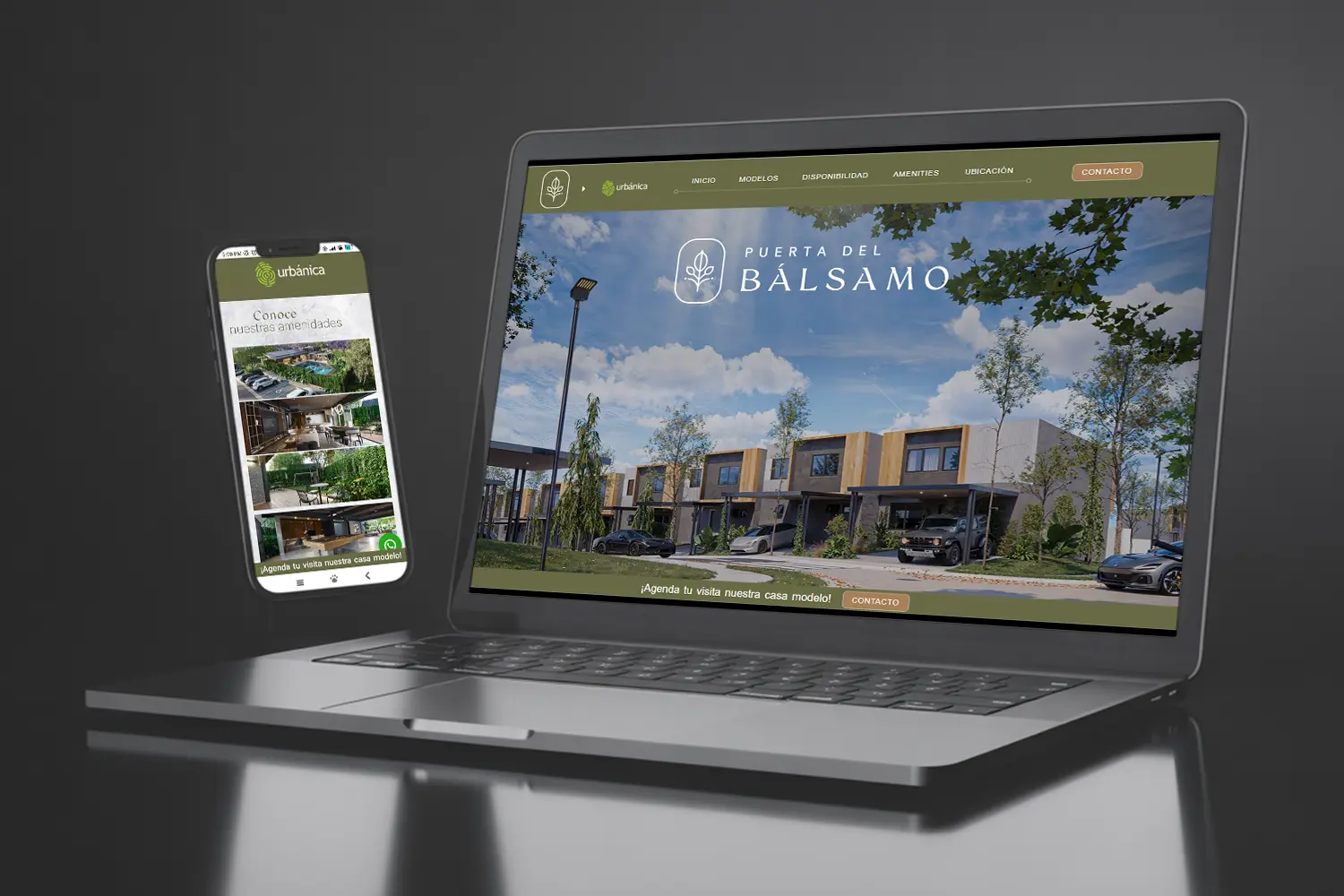
The way people discover, compare, and choose real estate projects has changed structurally. Today, the first visit to a project no longer happens in the sales office—it happens online. In fact, most buyers begin their home search digitally, using websites, portals, and visual content before having any contact with a sales advisor.
In this new context, a key question emerges for builders and developers:
How do you make a digital visitor truly understand, value, and connect with a real estate project?
The answer lies in immersive real estate websites.
What is an immersive real estate website?
An immersive real estate website is a digital platform designed for users to experience the project rather than simply view it passively. It combines advanced UX/UI design, 3D visualization, 360° virtual tours, interactive catalogs, and integrated commercial information to simulate—when possible—the feeling of being physically inside the project.
Unlike a traditional real estate website—based on static images, long text blocks, and PDFs—an immersive site allows users to:
- Explore spaces, views, and amenities.
- Compare layouts and available units.
- Understand the project intuitively, without excessive cognitive effort.
For a complete view of how these platforms are structured and integrated into a commercial strategy, read the immersive web experiences real estate guide for 2026.
Why traditional websites are no longer enough
For years, the standard in real estate marketing was the digital brochure: attractive renders, downloadable floor plans, and a general project description. However, consumer behavior research shows buyers retain information better when they actively interact with it—especially for complex, high-value products like housing.
On a traditional site:
- The user must imagine how spaces connect.
- Comparing options is slow.
- Uncertainty is pushed onto the sales team.
On an immersive site:
- The user experiences the project digitally.
- Information is understood visually and in context.
- Trust increases before the first sales contact.
This shift explains why more and more developers are moving toward interactive real estate experiences as the new standard for digital presentation.
When it makes sense to implement an immersive real estate website
Not every project requires the same level of digital sophistication, but there are scenarios where an immersive website makes a clear impact:
- Pre-sales and off-plan sales, where the project does not yet physically exist.
- Premium or boutique projects, where experience is part of the value.
- Tourism or vacation developments, with remote buyers.
- Sales to international investors, especially in markets like Florida or the Caribbean.
- Portfolios with high inventory, requiring fast unit-to-unit comparison.
In these cases, the website stops being just an informational channel and becomes an active sales tool.
Key components of an immersive real estate website
Although every project is different, the most effective immersive sites usually integrate:
1. UX/UI design oriented to decision-making
Design is not just aesthetic. A strong user experience:
- Prioritizes clarity.
- Reduces friction.
- Guides visitors toward the information that truly matters.
This approach is especially relevant in web design for builders, where navigation should reflect real commercial criteria (price, view, availability, layout).
2. Virtual tours and 3D visualization
Real estate virtual tours help users explore apartments, shared areas, and surroundings—improving spatial understanding and reducing buyer uncertainty.
3. Interactive catalogs
Users can filter units, compare options, and access specific information without depending on an advisor from the start.
4. Integration with sales tools
When the website connects to sales systems, lead follow-up becomes more efficient and the sales process becomes more organized.
If you want to go deeper into structure, components (3D, 360°, interactive catalogs) and how to connect an immersive website to your sales process, check the Immersive Web Experiences Real Estate Guide (2026).
How an immersive website strengthens a real estate brand
Beyond direct conversion, an immersive website plays a key role in brand positioning. It communicates:
- Innovation.
- Professionalism.
- Trust.
- Consistency between the sales message and the digital experience.
In an increasingly competitive market—where many projects fight for the same buyer’s attention—the digital experience becomes a real differentiator, not just a visual add-on.
First step to evaluate whether your project needs it
If you’re evaluating whether an immersive website is right for your project, a good starting question is:
Does my current website help people make decisions—or does it only show information?
When the answer is “it only shows,” it’s usually time to evolve toward a more interactive, immersive model.
To understand how to make that leap strategically, review the complete guide on immersive web experiences for builders and real estate companies—or book an initial diagnostic.
2026 Guide
Want to see what your project would look like before it’s built?
Explore how immersive web experiences work—and the impact they can have on your sales.