


“You’re not just selling square meters, you’re selling a dream.”
Real estate marketing is undergoing a structural transformation. In markets like Latin America and the United States (especially Florida), buyers conduct most of the project exploration and pre-selection process digitally before any physical interaction with a sales office. Studies from the National Association of Realtors show that over 95% of buyers use digital channels during their decision-making process, and that visual tools directly influence confidence and purchase speed (NAR, 2023). Digital experiences generate excitement, trust, and decision-making speed in the real estate buyer's mind.
In this context, immersive web experiences are no longer just an aesthetic resource—they become a strategic sales asset.
ACCELERATE YOUR SALES CLOSURE
See your next project in immersive format
Don't let your leads get lost in static renders. Book a session with an Appicua expert and receive a free diagnosis of your current digital ecosystem.
1. What is an immersive real estate website and when should you use it?
An immersive real estate website is a digital platform that combines advanced visualization (3D, 360° tours), UX design focused on conversion, and integrated commercial data, allowing users to experience the project in a way that closely resembles a physical visit.
From both academic and business literature, these environments are associated with the concept of experiential marketing, where sensory and cognitive experiences enhance perceived value and purchase intent (Pine & Gilmore, 1999; HBR, 2022).
When is it recommended for greater impact?
- Premium, boutique, or luxury projects, where experience is key to justifying value.
- Presales or off-plan sales.
- Tourism, vacation, or international developments.
- Sales teams selling remotely or to foreign investors.
- Projects with high inventory that require quick and comparable decisions.
2. Key components of an immersive web experience
Real estate UX/UI focused on conversion
UX evidence shows that cognitive clarity reduces friction and accelerates decisions. User-centered design research indicates that well-structured interfaces can improve conversion rates by 20% to 40%, depending on the context (Nielsen Norman Group, 2020).
It’s not just about attractive design—it’s about the science behind the user experience, which translates to:
- Reduced navigation friction. Less mental effort for the buyer.
- Clear visual hierarchy of price, view, and availability.
- Guides users to relevant floorplans, views, and prices.
- Prioritizes emotions + commercial clarity.
Multimedia, 360° virtual tours, and 3D visualization
Various academic and industry studies have shown that immersive visualization improves spatial understanding and buyer confidence. A report from Stanford University on virtual environments found that users retain more information and build stronger emotional connections with spaces when presented in immersive formats rather than static images (Stanford Virtual Human Interaction Lab, 2018).
Multimedia, virtual tours, and 3D allow users to:
- Explore apartments, common areas, and surroundings.
- Compare views, floor levels, and orientations.
- Increase confidence and reduce unnecessary site visits.
In real estate, professional associations report that these features:
- Increase time spent on the website.
- Boost the likelihood of commercial contact.
- Reduce unnecessary physical visits (NAR, 2023).
Interactive catalogs and connected inventory
From an information systems perspective, real-time inventory integration reduces information asymmetry, one of the main barriers to purchase decisions (Shiller, 2015). When users can compare units, views, and prices autonomously, the process becomes more transparent and efficient.
It’s also a tool that makes the sales process more efficient, especially when used at real estate fairs or events with a large number of prospects.
Through interactive catalogs and real-time inventory, users can:
- Filter by layout, price, view, or availability.
- See floor plans, areas, and specific renders per unit.
- Clearly understand what they are buying.
Integration with real estate CRM
McKinsey (2020) identifies the integration of digital marketing and commercial systems as one of the main productivity enablers in real estate sales. The website stops being a passive channel and becomes an active node for capturing, qualifying, and prioritizing leads.
The website becomes not just a marketing tool but a commercial asset:
- Leads are directly connected to the CRM (HubSpot, Salesforce, etc.).
- Automatic tracking of interest by unit.
- Better scoring and lead prioritization.
Campaign-focused real estate landing pages
Real estate landing pages are designed for specific campaigns, allowing for better lead retention and generation.
Generally, they are created for:
- Google Ads, Meta or Facebook Ads, and LinkedIn Ads.
- Specific projects, launches, or real estate fairs.
- Efficient capture of high-intent leads.
3. Direct sales impact: key metrics
Although results vary depending on the market and type of project, industry evidence reveals common patterns:
- Shorter sales cycle, up to 30%, by reducing the initial exploration phase (McKinsey, 2020).
- Higher lead quality, as they arrive better informed to the commercial interaction (NAR, 2023). Lead volume can increase by +40%.
- Increased conversion and closing rates when the digital experience reduces uncertainty (PwC, 2019).
- Higher average ticket, due to improved value perception by potential buyers.
- Sales team optimization: less time explaining, more time closing.
PwC (2019), in its study on virtual and augmented reality, estimates these technologies can significantly speed up decisions in sectors where product visualization is key, such as real estate and construction.
4. Success stories (real results)
The case-based evidence literature in real estate tech shows that developers and real estate agencies that migrate from static materials to interactive experiences:
- Increase digital engagement.
- Improve alignment between marketing and sales.
- Reduce commercial rework (McKinsey, 2020).
These results are consistent with experiences reported in Latin American real estate projects that have implemented interactive visualization and integrated CRMs.
Success Stories
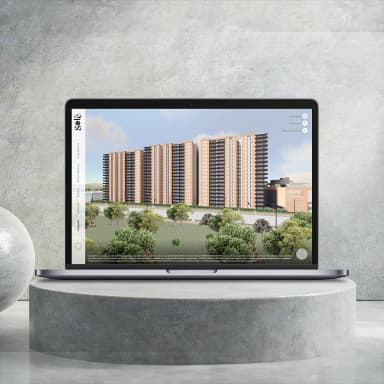
Solé
Solé is an interactive experience designed to showcase the features of a real estate project in northern Bogotá. Through a virtual model, users can explore the project in detail, including available apartments, nearby locations, access roads, and common areas. This experience allows potential buyers to get a comprehensive view of all the advantages and details of the project, offering a clear and appealing vision of their future home.
Kubik Verde
Kubik Verde is a multimedia tool developed to showcase the features of a country condominium located in Sopó, Colombia. The project offers lots and houses in a natural and peaceful environment. Through this interactive tool, potential buyers can explore project details such as location, types of houses, finishes, common areas, and lot availability, providing an informative and engaging buying experience.

5. How to calculate the ROI of an immersive website
Reducing the sales cycle and improving lead quality has a direct impact on the present value of commercial cash flows, a particularly relevant factor in real estate presales (Geltner et al., 2014).
Step 1: Identify your current variables
- Monthly leads.
- Closing rate.
- Average ticket.
- Sales cycle duration.
Step 2: Conservative projection
- +20–40% in qualified leads.
- −20–30% in sales cycle duration.
- +10–15% in average ticket.
Step 3: Comparison
Investment in digital experience vs. increase in sales and cash flow speed.
RESOURCE FOR SALES MANAGERS
How much could you save by shortening your sales cycle by 30%?
Download our real estate ROI calculator. Enter your current metrics and project the financial impact of implementing an immersive web experience on your cash flow.
6. Purchase checklist: how to choose the right partner
Evidence from complex digital projects shows that success depends more on integration and management capacity than on isolated technology (PMI, 2021). Before hiring an agency or provider, make sure to validate:
- Do they have real experience in real estate web development?
- Do they integrate UX, technology, and sales (not just design)?
- Do they connect with your CRM and sales processes?
- Can they scale to multiple projects and countries?
- Do they offer ongoing post-launch support?
7. Frequently Asked Questions (FAQ)
- Does this replace my sales office? No. It enhances it. The website becomes your sales accelerator.
- Is it suitable for VIS (affordable housing) projects or just luxury? It works for both. The level of complexity, refinement, and visualization adjusts according to the added value of each project.
- Can I integrate it with my current CRM? Yes. It's one of the core pillars.
- Is it useful for selling in other countries or to foreign clients? Especially. It reduces geographic barriers and accelerates decisions.
ACCELERATE RESULTS
We know how real estate is sold today: with data and emotion
At Appicua, we understand your priority is cash flow speed. We don’t just offer technology—we bring a proven methodology in LATAM and the USA to optimize your sales funnel. Let’s talk for 30 minutes to diagnose your project and show you a demo that will change your sales perspective.
References
- Geltner, D., Miller, N., Clayton, J., & Eichholtz, P. (2014). Commercial real estate analysis and investments (3rd ed.). OnCourse Learning.
- Harvard Business Review. (2022). How virtual experiences are changing customer decision-making.
- McKinsey & Company. (2020). The future of real estate: How digital will transform the industry.
- National Association of Realtors. (2023). Real estate in a digital age.
- Nielsen Norman Group. (2020). UX conversion rate optimization research.
- Pine, B. J., & Gilmore, J. H. (1999). The experience economy. Harvard Business School Press.
- PwC. (2019). Seeing is believing: How VR and AR will transform business and the economy.
- Stanford Virtual Human Interaction Lab. (2018). The psychology of virtual reality.
- Westerman, G., Bonnet, D., & McAfee, A. (2014). Leading digital: Turning technology into business transformation. Harvard Business Review Press.